
 go back to Projects
Recording Manchester’s recent telecommunications heritage
A newly funded community based project

_logo.jpg)
Introduction - capturing memories
Working in partnership with the University of Salford’s Centre for Applied Archaeology, we have a programme of work to record, document and disseminate Manchester’s rich telecommunications heritage. This particular project is funded by the Council for British Archaeology North West through their small grant scheme and makes an important contribution towards achieving that overall aim. Specifically, we want to capture the knowledge and experiences of people who worked within telecommunications in Manchester. Where archival records exist they tend to note key press launch dates and major events but not day-to-day operational detail, for that resides in the memories of the staff working for the various companies. Such personal knowledge has to date been an untapped resource but represents a rich archaeological seam of information which we now wish to capture. In the first instance we want to engage with people who worked for telecommunication companies in technical, operational, managerial and administrative roles located within the general area of central Manchester and its border with Salford.
How can YOU help?

Buildings change, memories fade, heritage becomes eroded
Telecommunications has had, and continues to have, a transformational impact on our society. In the last sixty years the expansion of telephone ownership, the development of broadband internet access and now the dominance of the smartphone have all revolutionised the way we communicate, do business, access and consume information. These developments also impact the physical word around us. In a city such as Manchester, new technology replaces old, buildings are demolished, or re-purposed and street furniture is both installed and removed. However, these changes and the pace at which they occur, create challenges for industrial archaeology and heritage.
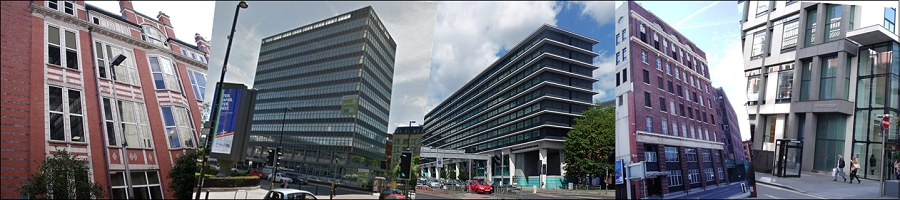
Greater Manchester is a prime example of the nature of the challenge faced when trying to compile a detailed and complete historical record. The region has always played an important role in telecommunications; indeed, the first telephone installed anywhere in the UK under licence to the Post Office was in Manchester in 1878. Much later, the South Lancashire Radio Telephone Service, a precursor to today’s mobile phone, was launched in 1959 centred on Telephone House in New York Street, central Manchester; a building now repurposed as general offices. Dial House in Salford, in 1977 became part of the UK’s first public packet-switched digital network, a forerunner to today’s Internet. This building continues to be an important telephone exchange for BT but what records exist of its earlier significance? The world’s first commercial International video conferencing service, Confravision, opened in 1974 in Bridgewater House, Manchester. That building was also, at one time, the local headquarters of BT but which now shows no signs of its previous incarnations. In 1996, Nynex pioneered the use of cable modems to provide 10Mbps high speed internet access to homes, a revolutionary speed for its day. Yet, Nynex now only exists as a name on pavement utility access plates. In 1997 Norweb Telecom, a local company long since gone, achieved a world first by connecting a local school to the Internet using the electrical power network.
More recently, BT has announced that in 2025 it will be decommissioning the national digital telephone network that was launched in the mid-1980s. This will see a wholesale removal of equipment and buildings for a technology that Manchester was once regarded as leading the country. Hence, very soon the 40-year-old knowledge and experience of that technology and its impact on Manchester will start to fade.
Slowly but surely, our telecommunications heritage is being eroded.
Follow on social media .....